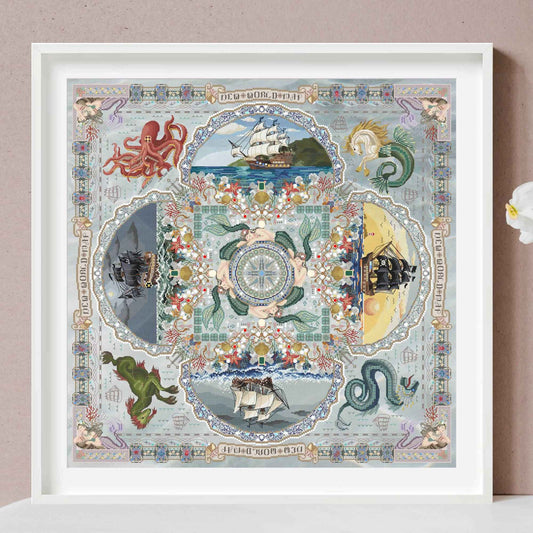
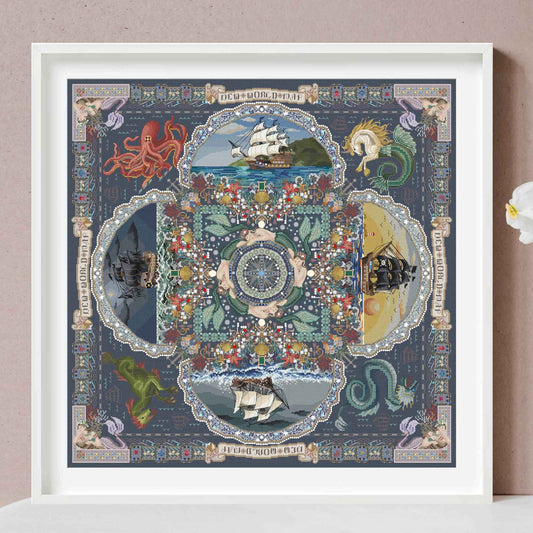
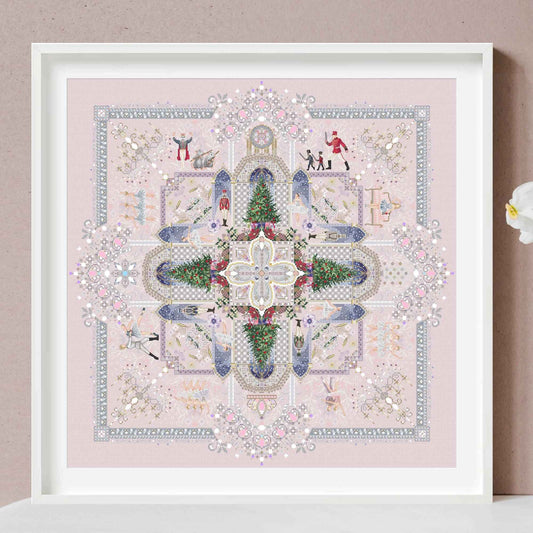
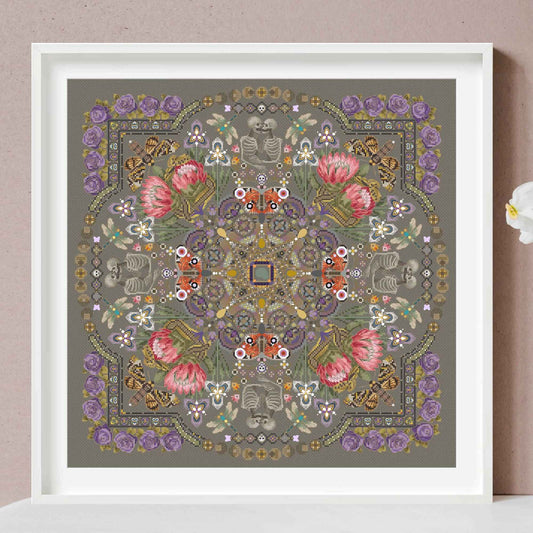
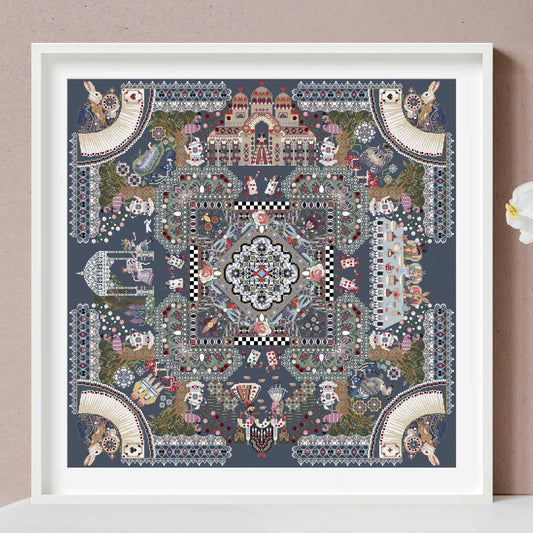
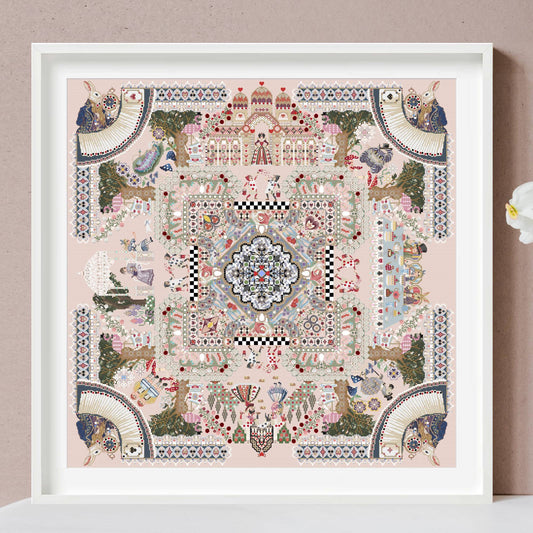
When I began working on the Alice in Wonderland Mandala Cross Stitch PDF, I knew I did not want to create another illustration of Alice falling down the rabbit hole.
There are already countless beautiful interpretations of that familiar scene. Instead, I wanted to ask a different question: What if the entire story could be transformed into a single mandala?
A Story Map, Rather Than a Single Scene
Lewis Carroll’s Alice’s Adventures in Wonderland is filled with characters, objects, conversations, symbols, and peculiar places. Rather than choosing one moment from the story, I wanted to bring these fragments together and let them coexist within one composition.
Alice is therefore not simply placed inside Wonderland. The design becomes a kind of visual map of her journey.
The familiar figures and objects are arranged around the central structure, while smaller details reveal themselves gradually. The White Rabbit, the Mad Hatter, the Queen, playing cards, curious objects, and architectural elements are not there simply as decoration. They act as clues.
The intention is that the longer you look, the more you discover.
Why a Mandala?
A mandala gave me the structure I needed to bring such an unpredictable story together.
Wonderland itself has very little interest in behaving logically. Its scale changes, its characters contradict themselves, and its rules seem to appear and disappear without warning. A circular and symmetrical framework provides an intentional contrast to that sense of absurdity.
The structure is orderly.
The story inside it is not.
That tension became one of the most important ideas behind the design.
Instead of illustrating Wonderland exactly as it appears in the book, I treated its visual language almost like an ornamental archive. Characters, symbols, objects, and fragments of architecture are carefully placed into layers, creating a composition that feels decorative at first glance but narrative when examined more closely.
Details Meant to Be Discovered
I also wanted the design to reward close observation.
For this reason, the pattern contains numerous smaller elements rather than relying entirely on one large central illustration. Fine motifs, ornamental borders, miniature narrative details, and embellishments create different levels of visual information.
This is especially important for cross stitch.
A printed illustration can be understood in seconds. A stitched piece is different. You spend hours with it.
I wanted those hours to feel like exploration.
The beadwork and embellishments were therefore chosen not simply to make the finished piece more elaborate, but to create moments of light and texture among the stitched details. At a distance, they contribute to the overall jewel-like appearance. Up close, they become another layer of the story.
Keeping Wonderland Elegant
There was another decision that mattered just as much: I did not want the design to become overly childish.
Alice in Wonderland is often interpreted through bright colours, cartoon-like characters, and playful fantasy. Those approaches can be charming, but they were not right for TOTOOSTITCH.
Instead, I wanted something more restrained and ornamental, with a sense of an antique illustrated book or a carefully assembled curiosity.
The colour palette, decorative structure, and embellishments were all considered with this in mind. Wonderland could remain strange and playful without losing its sense of elegance.
A Different Way to Read Alice
Ultimately, this design is not intended to replace the original illustrations or create a literal reconstruction of Wonderland.
It is my interpretation of what it might feel like to carry the story with you.
Every small element is an invitation to remember a character, a conversation, an object, or a strange moment from Alice’s journey. And because cross stitch takes time, the relationship with the story changes as the work progresses.
You do not simply look at Wonderland.
You spend time there.
That was the idea behind this Alice in Wonderland Mandala Cross Stitch PDF: to turn a familiar literary world into something that can be slowly explored, stitched, and eventually kept as a piece of visual storytelling.
©2026 Ting-Chao, Yan /TotooStitch. All rights reserved.